Friday, 31 October 2014

This Dark Nebula Looks Like it is Writhing in Agony

LBN 438 is a dark nebula and can be found in the constellation Lacerta. Credit and copyright: Adam Block/Mount Lemmon SkyCenter/University of Arizona.
We’ve got at least one scary night ahead with Halloween falling on Friday. Adam Block, manager at the Mount Lemmon SkyCenter at the University of Arizona sent us this image of the nebula LBN 438, explaining that this dark cloud of dust glows eerily both from scattered starlight and extended red emission due to the radiation of a nearby star.
“My mind alternates between something dancing in ecstasy or writhing in torture,” Adam said. “Either way, very spooky…”

Adam just happens to have access to a 32-inch Schulman Telescope (RCOS) at Mt Lemmon, and used a SBIG STX16803 CCD Camera to get this scary shot.

Tuesday, 28 October 2014

The Milky Way over Lake Annette in Jasper National Park, Alberta, a Dark Sky Preserve, on October 24, 2014. Credit and copyright: Alan Dyer/Amazing Sky Photography.
Does it get any more gorgeous than this? What an absolutely beautiful view of the night sky over Lake Annette and Whistler’s Mountain in Jasper National Park.
“I shot this at the Lake Annette Star Party, one of the Dark Sky Festival events, using the Canon 60Da and 10-22mm lens at 10mm f/4 and ISO 3200 for 1 minute, untracked,” said prolific astrophotographer Alan Dyer on Flickr. “Shot October 24, 2014, with fresh snow on Whistler across the lake and valley and on a calm night with still waters reflecting the stars.”

Saturday, 25 October 2014


Skydiver Goes Supersonic in Record-Breaking 'Near-Space Dive

Baumgartner set the previous record on Oct. 14, 2012, when he stepped out of a specially built capsule that was lifted by a balloon 128,000 feet (39,000 m) above Earth. Eustace didn't ride inside any kind of pod, but was instead attached to the balloon directly. He was only protected from the harsh environment outside by his spacesuit, made by ILC Dover, a company known for making spacesuits for NASA astronauts.
Eustace, 57, was already an experienced skydiver and pilot when he came to Paragon, Anderson said, but he required extra training and had to complete a series of increasingly difficult test dives before today's feat. Eustace also had to learn how to move around in his high-tech pressure suit, which weighs some 400 lbs. (181 kilograms)
"It's not a suit you would wear to walk your dog around the block," Anderson said.
The team decided against using a capsule because it would have presented additional problems — more weight for the balloon to carry and two life-support systems.
"Designing a suit that would just keep him alive and comfortable for the whole period of time seemed like a simpler way to do it," Anderson told Space.com.
Eustace remained in free fall for approximately 4.5 minutes before deploying his parachute, according to Paragon representatives. During that time, he became the second person ever to break the sound barrier outside an aircraft. (Baumgartner was the first.) After another 14 minutes spent drifting back to Earth's surface by parachute, Eustace safely tumbled to the ground about 70 miles (113 km) from his launch point in Roswell, New Mexico. Anderson told Space.com that the skydiver was "in perfect shape."
Alan Eustace carried off Earth
Alan Eustace was carried into the stratosphere with a high-altitude scientific balloon.
Credit: Paragon Space Development Corporation®
Eustace also set the world record for free fall under a drogue chute, as well as national records for highest exit altitude and vertical speed, according to Paragon representatives.
"I always wondered: what if you could design a system that would allow humans to explore the stratosphere as easily and safely as they do the ocean?" Eustace said in a statement. "With the help of the world-class StratEx team, I hope we've encouraged others to explore this part of the world about which we still know so little."
The dive from the stratosphere required 34 months of preparation by Paragon and its StratEx team, which developed the balloon, spacesuit and accompanying support systems.
One of Paragon's co-founders, Jane Poynter, is CEO of World View, a company that hopes to take paying customers on balloon rides to near-space inside of a sealed capsule.

Wednesday, 22 October 2014

Mr. Fusion? Compact Fusion Reactor Will be Available in 5 Years Says Lockheed-Martin

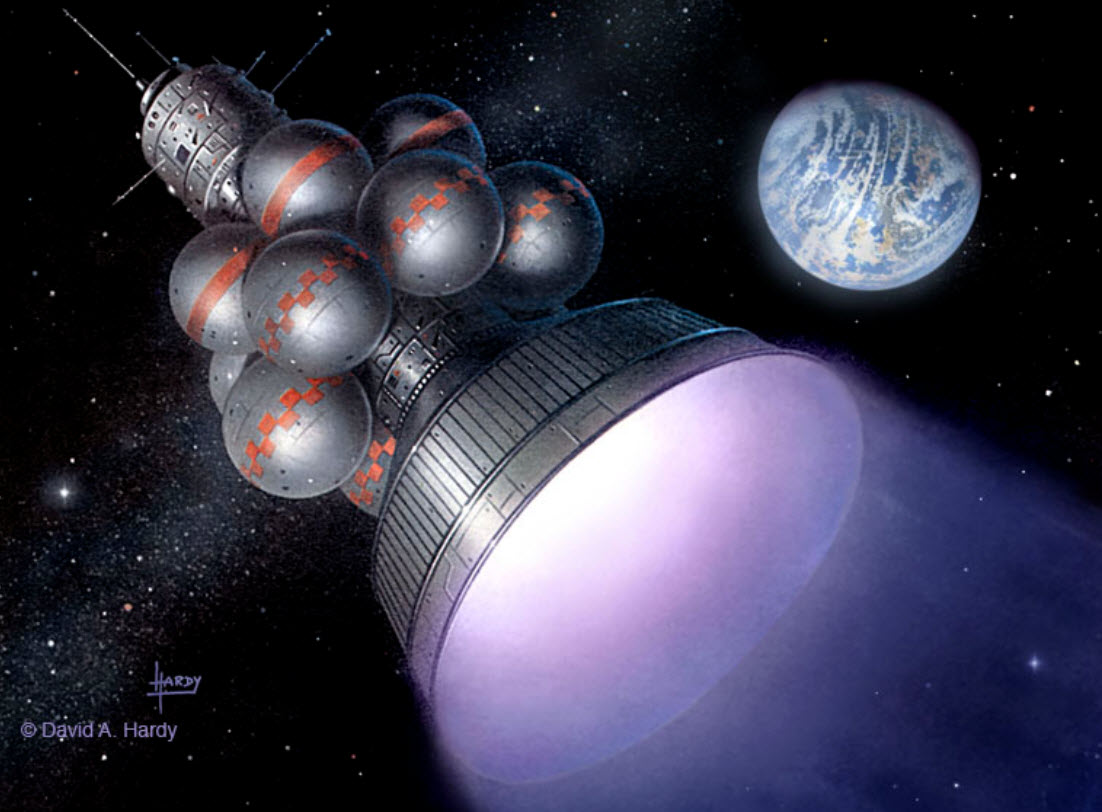
Could the future of fusion driven rockets for interplantary or even interstellar travel be near at hand? Engineers at the Lockheed-Martin Skunk Works believe they will have a compact fusion reactor prototype operational in five years and in use within 10 years. (Illustration Credit:© David A. Hardy/www.astroart.org,  Project Daedalus)
Could the future of fusion driven rockets for interplantary or even interstellar travel be near at hand? Engineers at the Lockheed-Martin Skunk Works believe they will have a compact fusion reactor prototype operational in five years and in use within 10 years. (Illustration Credit:© David A. Hardy/www.astroart.org, Project Daedalus)
The Farnsworth Fusor; Pons and Fleishmann. It seems the trail to fusion energy has long gone cold — stone cold, that is, and not cold as in cold fusion. Despite the promise of fusion providing a sustainable and safe energy source, fusion reactors are not a dime a dozen and they won’t be replacing coal fired power plants any time soon. Or will they? Lockheed-Martin Skunk Works announced a prototype compact fusion reactor that could be ready within five years. This revelation has raised eyebrows and sparked moments of enthusiasm.
But, let’s considers this story and where it all fits in both the history and future.

For every Skunk Works project that has made the runway such as the Stealth Fighter or SR-71 Blackbird, there are untold others that never see the light of day. This adds to the surprise and mystery of Lockheed-Martin’s willingness to release images and a detailed narrative describing a compact fusion reactor project. The impact that such a device would have on humanity can be imagined … and at the same time one imagines how much is unimaginable.
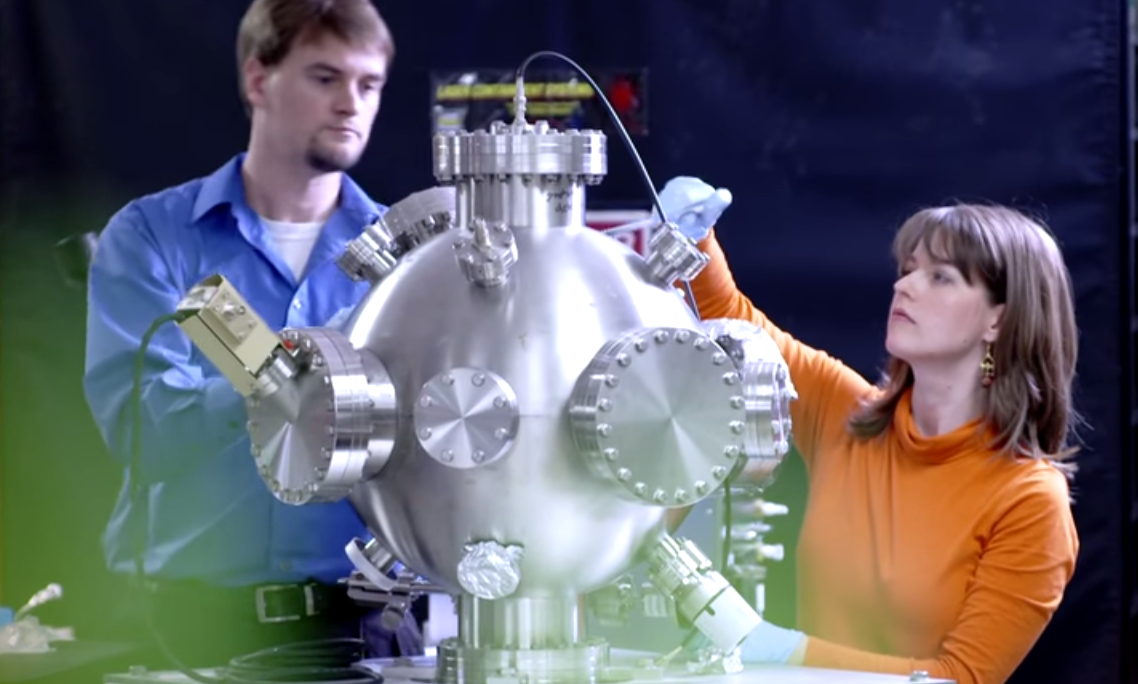
Lockheed-Martin engineers in the Skunkworks prepare a vessel, one component of an apparatus that they announced will lead to nuclear fusion in a truck-sized reactor within 5 years. An international effort is underway in Europe to create the worlds first practical tokamak fusion reactor, a much larger and costlier design that has never achieved the long sought "breakeven" point. (Photo Credit: Lockheed-Martin)
Lockheed-Martin engineers in the Skunkworks prepare a vessel, one component of an apparatus that they announced will lead to nuclear fusion in a truck-sized reactor within 5 years. An international effort is underway in Europe to create the world’s first practical tokamak fusion reactor, a much larger and costlier design that has never achieved the long sought “breakeven” point. (Photo Credit: Lockheed-Martin)
The program manager of the Skunk Works’ compact fusion reactor experiment is Tom Maguire. Maguire and his team places emphasis on the turn-around time for modifying and testing the compact fusion device. With the confidence they are expressing in their design and the ability to quickly build, test and modify, they are claiming only five years will be needed to reach a prototype.
What exactly the prototype represents was left unexplained, however. Maguire continues by saying that in 10 years, the device will be seen in military applications and in 20 years it will be delivered to the world as a replacement for the dirty energy sources that are in use today. Military apps at 10 years means that the device will be too expensive initially for civilian operations but such military use would improve performance and lower costs which could lead to the 20 year milestone moment if all goes as planned.
Their system uses magnetic confinement, the same basic principle behind the tokamak toroidal plasma confinement system that has received the greatest attention and government funding for over 50 years.
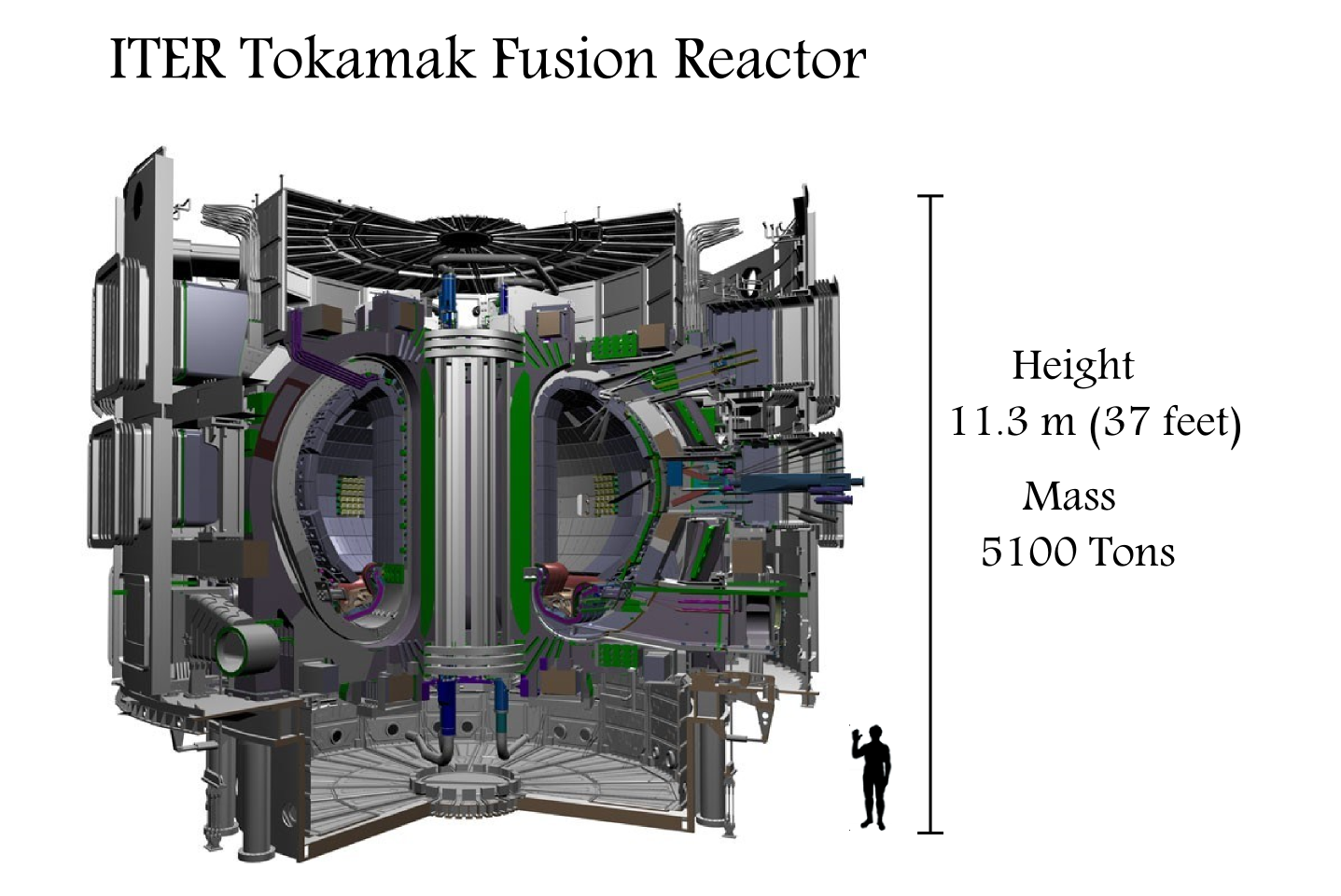
The ITER Tokamak Fusion Reactor is expected to begin operational testing in 2020 and begin producing deuterium-tritium fusion reactions in 2027. (Credits: ITER, Illus. T.Reyes)
The International Thermonuclear Experimental Reactor (ITER) is currently under construction in Europe under the assumption that it will be the first net energy producing fusion generator ever. It is funded by the European Union, India, Japan, People’s Republic of China, Russia, South Korea and the United States. But there are cost over-runs and its price has gone from $5 billion to $50 billion.
ITER is scheduled to begin initial testing in 2019 about the time Lockheed-Martin’s compact fusion reactor prototype is expected. If Lockheed-Martin succeeds in their quest, they will effectively have skunked ITER and laid to waste a $50 billion international effort at likely 1/1000th the cost.
There are a few reasons Lockheed-Martin has gone out on a limb. Consider the potential. One ton of Uranium used in Fission reactors has as much energy as 1,500 tons of coal. But fission reactors produce radioactive waste and are a finite resource without breeder reactors, themselves a nuclear proliferation risk. Fusion produces 3 to 4 times more energy per reaction than fission. Additionally, the fuel — isotopes of hydrogen — is available from sea water — which is nearly limitless — and the byproducts are far less radioactive than with fission. Fusion generators once developed could provide our energy needs for millions of years.
More pragmatically, corporations promote their R&D. They are in a constant state of competition. They present a profile that ranges from the practical to the cutting edge to instill confidence in their Washington coffers. Furthermore, their competitors have high profile individuals and projects. A fusion project demonstrates that Lockheed-Martin is doing more than creating better mouse-traps.
To date, no nuclear fusion reactor has achieved breakeven. This is when the fusion device outputs as much energy as is input to operate it. Magnetic confinement such as the various tokamak designs, Lawrence Livermore’s laser-based inertial confinement method, and even the simple Philo Farnsworth Fusor can all claim to be generating energy from fusion reactions. They are just all spending more energy than their devices output.
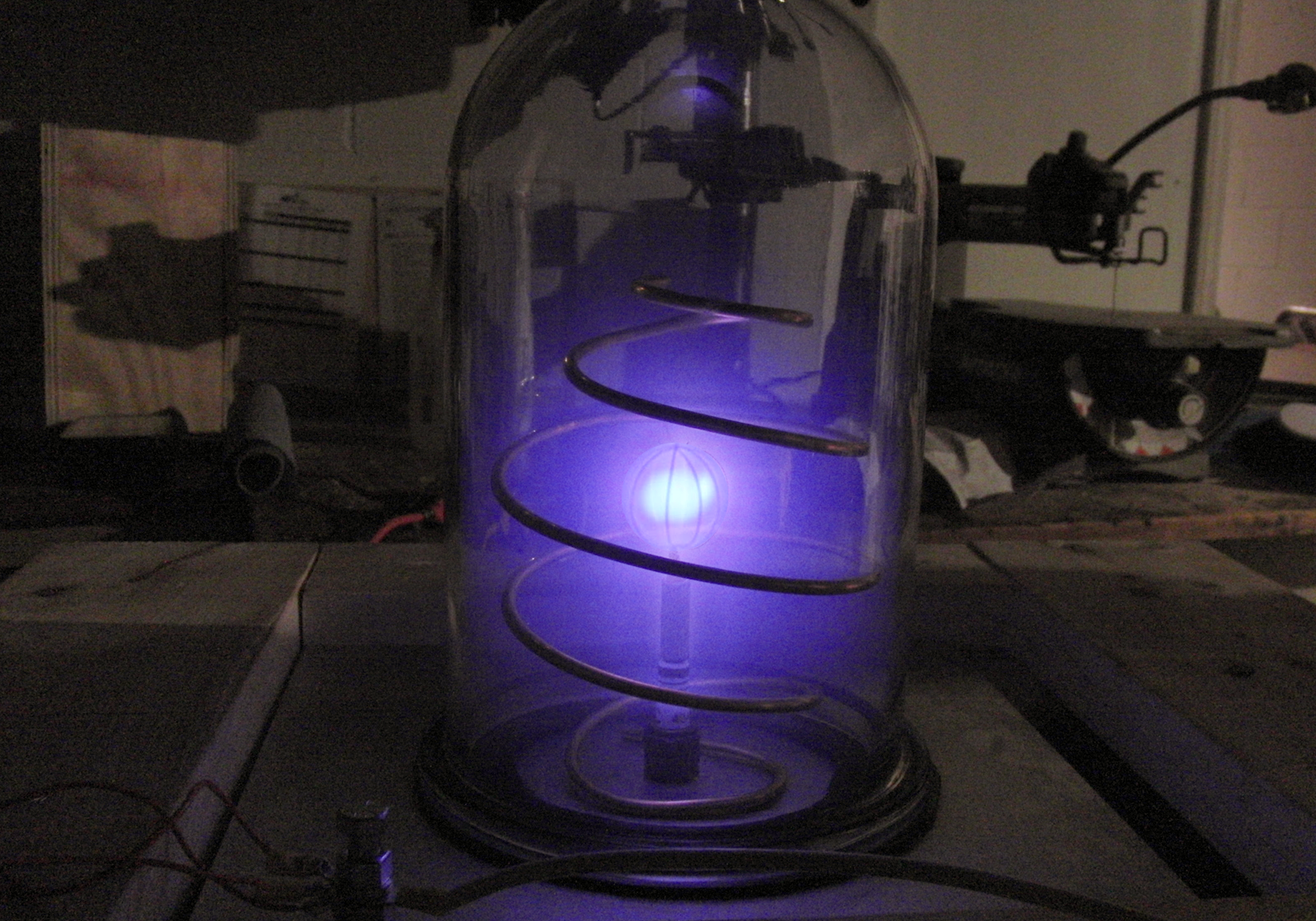
An example of a homemade Fusor. Originally invented in the 1960s by the inventor of the television, Philo Farnsworth. (Credit: Wikipedia, W.Jack)
The fusor, invented in the 1960s by Farnsworth and Hirsh, is a electrostatic plasma confinement system. It uses electric fields to confine and accelerate ions through a central point at which some ions will collide with sufficient energy to fuse. Although the voltage needed is readily achieved by amateurs – about 4000 volts – not uncommon in household devices, no fusor has reached breakeven and theoretically never will. The challenge to reaching breakeven involves not just energy/temperature but also plasma densities. Replicating conditions that exist in the core of stars in a controllable way is not easy. Nevertheless, there is a robust community of “fusioneers” around the world and linked by the internet.
Mr Fusion, the compact fusion reactor that drove the 21st Century version of the DeLorian in Back to the Future. The movie trilogy grossed $1 billion at the box office. Mr Fusion could apparently function off of any water bearing material. (Credit: Universal Pictures)
Mr Fusion, the compact fusion reactor that drove the 21st Century version of the DeLorean in Back to the Future. The movie trilogy grossed $1 billion at the box office. Mr Fusion could apparently function off of any water bearing material. (Credit: Universal Pictures)
It remains to be seen who, what and when a viable fusion reactor will be demonstrated. With Lockheed-Martin’s latest announcement, once again, fusion energy is “just around the corner.” But many skeptics remain who will quickly state that commercial fusion energy remains 50 years in the future. So long as Maguire’s team meets milestones with expected performance improvements, their work will go on. The potential of fusion energy remains too great to dismiss categorically.

Monday, 20 October 2014


Who Owns the Moon? (Op-Ed)


Expert-voices-banner
Real estate on the moon

This article was originally published at The Conversation. The publication contributed the article to Space.com's Expert Voices: Op-Ed & Insights.
Whether you’re into mining, energy or tourism, there are lots of reasons to explore space. Some “pioneers” even believe humanity’s survival depends on colonising celestial bodies such as the moon and Mars, both becoming central hubs for our further journey into the cosmos. Lunar land peddlers have started doing deals already – a one-acre plot can be yours for just £16.75.
More seriously, big corporations, rich entrepreneurs and even US politicians are eyeing up the moon and its untapped resources. Russia has plans for a manned colony by 2030 and a Japanese firm wants to build a ring of solar panels around the moon and beam energy back to Earth.


Friday, 17 October 2014

U.S. Air Force lands robotic X-37B space plane in California

Reuters
x37b_otv
.
View photo
The X-37B Orbital Test Vehicle taxis on the flightline in June 2009 at Vandenberg Air Force Base, Calif. …
By Steve Gorman

LOS ANGELES (Reuters) - The U.S. military landed its X-37B robotic space plane at Vandenberg Air Force Base in central California on Friday, ending a classified 22-month mission that marked the third in Earth orbit for the experimental program, the Air Force said.
The X-37B, a 29-foot-long (9-meter) winged craft that resembles a miniature NASA space shuttle, touched down at 9:24 a.m. local time at the coastal air base and launch facility near Lompoc, California, 160 miles (258 km) northwest of Los Angeles.
Also known as the Orbital Test Vehicle, the X-37B was carried into orbit for its latest mission aboard an unmanned Atlas 5 rocket from Cape Canaveral Air Force Station in Florida on Dec. 11, 2012.
The spacecraft conducted unspecified experiments for 674 days while in orbit, marking the lengthiest mission to date for the secretive program, which is managed by the Air Force Rapid Capabilities Office, the Air Force said.
The space plane first flew in April 2010 and returned after eight months. A second vehicle blasted off in March 2011 and stayed in orbit for 15 months. Those first two missions also ended at Vandenberg.
The Air Force says the orbiters, built by Boeing, "perform risk reduction, experimentation and concept-of-operations development for reusable space vehicle technologies," although details of the missions are secret.
Total program costs and budget line are likewise classified.
Last week, the Air Force and NASA finalized a lease agreement to relocate the space plane program from California to Florida’s Kennedy Space Center, where the runway once used for shuttle landings may be used for future X-37B touchdowns.
The Secure World Foundation, a nonprofit group promoting the peaceful exploration of space, says secrecy surrounding the orbital activities and payloads of the X-37B are almost certainly due to the presence of national intelligence-related hardware being tested or evaluated.
"The landing of OTV-3 marks a hallmark event for the program," an unnamed program manager said in a statement released by the Air Force's 30th Space Wing at Vandenberg.
The Air Force is preparing to launch the fourth X-37B mission from Cape Canaveral in 2015.
(Additional reporting by Irene Klotz in Cape Canaveral, Florida; Editing by Doina Chiacu and Will Dunham)

Wednesday, 15 October 2014


China Readies Moon Mission for Launch Next Week

China's Re-Entry Capsule
China’s lunar sample program involves upcoming re-entry capsule test to evaluate high-speed plunge into Earth’s atmosphere.
China is preparing to launch a mission next week that will help pave the way for an ambitious lunar sample-return effort.
The upcoming launch of the Chang'e 4 mission is expected to take place Oct. 23 from China's Xichang Satellite Launch Center, and will apparently send an experimental, recoverable probe to lunar orbit and back. The goal is to validate re-entry technology for Chang'e 5, a future robotic mission that will land on the moon, collect samples and return those specimens to Earth.
According to China's State Administration of Science, Technology and Industry for National Defense, the soon-to-fly craft is a backup probe of Chang'e 3 — the nation's first moon lander and rover, which successfully touched down on Earth's nearest neighbor in December 2013. 
Chang'e 4 will be adapted to verify technologies needed for Chang'e 5, the third step in China's methodical moon-landing program, according to Chinese news agencies.
China's Long March Booster
Long March booster being readied to support China's next mooncraft takeoff this month, dedicated to testing technology for future lunar sample-return mission.                                           
The challenging Chang'e 5 mission, set to launch around 2018, will require technological breakthroughs in numerous areas, such as moon landing and takeoff, sample collection and encapsulation, lunar-orbit rendezvous and docking and high-speed Earth re-entry, Chinese officials have said.
"We have begun to study how the Chang'e 5 will blast off from the moon and dock with the in-orbit re-entry capsule," said Wang Pengji, a space expert at the China Academy of Space Technology.
China’s newest moon probe arrived in August at the Xichang launch site, according to a statement from the administration.
4M Mission Dedicated to Fuchs
The 4M mission is dedicated to Manfred Fuchs who died early this year. 4M stands for the Manfred Memorial Moon Mission.
The state-run Xinhua news agency has reported that the plan is for the spacecraft to be launched to lunar orbit, then return to Earth at a blistering speed of more than 25,000 mph (40,230 km/h). It will parachute onto terra firma to complete its journey.
Onboard China's moon-bound booster is a hitchhiking payload provided by the European space technology company OHB AG. This private "4M mission" to the moon is dedicated to OHB founder Manfred Fuchs, who died earlier this year. (4M stands for the Manfred Memorial Moon Mission.)
Technical management of the 4M mission is led by LuxSpace of Luxembourg, an affiliate of OHB AG. LuxSpace chiefly develops microsatellites and actively participates in the OHB System-led Small GEO initiative.
The 31-pound (14 kilograms) 4M probe is designed to fly by the moon and then return Earthward.
LuxSpace Launch Preparation Team in China
LuxSpace launch preparation team in China has successfully completed the system functional tests and health checks of its 4M probe before integration with China's Long March 3C.
Tucked inside the small spacecraft are several scientific instruments, including a radio beacon that permits the sending of messages while testing a new approach to locate the spacecraft. LuxSpace is encouraging radio amateurs around the globe to receive the transmissions and send in data.
An additional instrument will measure radiation levels throughout the satellite's trajectory around the moon, using a special chip provided by Spanish company iC-Málaga.
The 4M lunar flyby amateur radio payload was shipped to the Xichang Satellite Launch Center on Oct. 2.